|
|
|||||||||
Table of Contents |
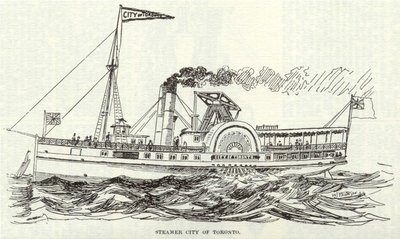
An Old Institution Threatened -Formidable Opposition--The New-Comer Wins. The Niagara route was, as usual, taken by the City of Toronto, under Captain James Dick, in 1874, she making her first trip on April 20th. There was no change either in 1875 until late in the season, when the City was joined by the Southern Belle. In 1876 the City and the Belle formed a joint line on the route, but again in 1877 the former had the road to herself.
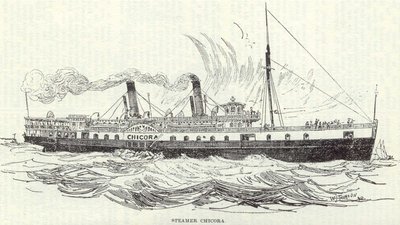
The City was in this season joined by the Rothesay, a sidewheel steamer of 528 tons burthen, built by Olive, of St. John, New Brunswick, at the same place, These two steamers ran in opposition to the Chicora and continued to do so until the close of the season of 1880. In the year 1882 the City was destroyed by fire at Port Dalhousie. The Rothesay went upon another route and the Chicora had the traffic, or rather the daily traffic, all to herself. The further history of the Niagara line is fully told elsewhere. The Niagara Navigation Co. -- Its Vessels and Their Captains -- 1878 to 1893. The Niagara Navigation Company began business in 1878, establishing a line of steamers to run between Toronto, Niagara-on-the-Lake and Lewiston. Their first vessel was the Chicora, which was already well known on the upper lakes, and whose name was during the first Northwest rebellion prominently before the public in connection with the transport of Colonel, now Lord, Wolseley'sRed River expedition. The Chicora was a large steel side-wheel steamer, her length being two hundred and thirty feet and her breadth fifty-two feet; her earlier history is given in another portion of these pages. The first officer placed in command of this popular vessel was Captain Thomas Harbottle, who for so many years was in command of the Passport, of the Royal Mail Line. It is almost needless to say that a better selection could not hove been made, Captain Harbottle having always been a most popular man, besides a clever and experienced sailor. Succeeding Captain Harbottle came Captain T. Leach, after him Captain J. McCorquodale, then Captain J. McGiffin. Following the latter came Captain W. H. Solmes, and on the appointment of this gentleman to another ship Captain James Harbottle, a son of the vessel's first master, assumed the command, at the beginning of the season of 1893. The Chicora continued single-handed for just ten years, until 1888, when the Cibola was placed upon the same route, and at the same time a small steamer known as the Ongiara, formerly the Queen City, which ran on Toronto harbour, was put upon the Niagara River, plying from Niagara-on-the-Lake to Lewiston on the American side. She connected with the steamers plying from Toronto.
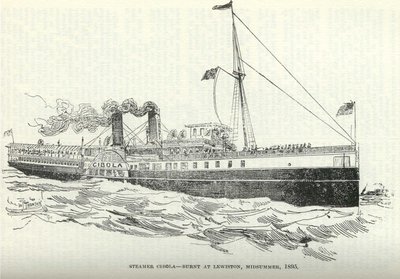
The engines are the work of Messrs. Rankin, Blackmore & Co., of Greenock, Scotland, who make a specialty of fast paddle engines for the celebrated Clyde passenger steamers. They are of the direct acting diagonal compound type, having two cylinders 47 inches and 85 inches in diameter, the stroke being 5 feet 6 inches. The saloon is finished in solid mahogany and with the ladies' cabin presents a handsome appearance. Electric lights are used throughout, in the stokeholes, in the engine rooms, forecastle, etc. The dining room and main saloon have three rows of lights down the centre of each, encircled with cut glass and opalescent globes. Above the main stairway hangs a chandelier of pierced brass with jewelled openings and containing clusters of lights. Her first commandant was Captain McCorquodale from the Chicora, after him was Captain McGiffin, and at the present time Captain W. H. Solmes is in command, Captain McGiffin having been transferred to the latest addition to the company's fleet, the Chippewa. The various individuals and firms engaged in building the Cibola were as follows:-- Designer, Robert Morton, Glasgow; steel hull, Dalzell Co.,Dalzell, Scotland; marine engines, Rankin, Blackmore & Co.,Greenock; erection of hull, W. White & Co., Montreal; erection of woodwork, Rathbun Company, Deseronto; mahogany and decoration, Wm. Wright & Co.,Detroit; electric lights, Edison Co , New York.
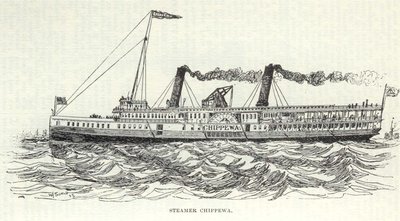
She was successfully launched at Hamilton on Tuesday, May 2nd, and received her name from Miss Gertrude Foy, and Miss Phyllis Hendrie. The Chippewa is 311 ft. over all with a total breadth of 67 ft., and a depth of 13 ft. 6 in. She is a side wheel vessel on the plan of the Hudson River steamers; her saloon is 192 ft. long and there are four large state rooms in birch, oak and mahogany. This splendid ship was built by Mr. William Hendrie, of the Hamilton Bridge Company, it being his daughter who officiated at the launch and naming of the vessel. Every one in Canada knows both where the town of Chippawa is, and why it is so called, but the steamer just described takes its name not from that town, but from a famous man-of-war on the lake in 1812, called after the Indian chieftain. Every one, though, may not be quite as familiar with the names of the two other steamers just spoken of, so a few words of explanation may be here given:-- When the Spaniards, about 1580, following the lead of their great compatriot, Christopher Columbus, created settlements upon the southern portions of what is now the United States, some enterprising adventurers took home to Spain the Indian Chief who at the time ruled over the country from Florida to the Mississippi, then called " CHICORA," the " Land of Flowers." The king created the chief "Don Francesco de Chicora," and gave to him and to his introducers a royal grant of all the country that bordered on the Gulf of Mexico. Armed with this they returned to America and extended their enterprises across the Mississippi. Reaching the plains they found the buffalo and therefore called this new province which was added to their domain, "Cibola," the "Land of the Buffalo." What, then, could be better when the Chicora called for a new sister than that the name of the sister province should be given her ? Apart from the happily fitting names, they are singularly appropriate to the boats, and it is much to be wished that Cibola, " the buffalo;" Chicora, "the pretty flower;" and Chippewa, "the chieftain," may long continue a successful career upon their route between Toronto and Lewiston, working in the interest of the Niagara River Line. The present president of the Niagara Navigation Company is Sir Frank Smith, the vice-president being Mr. Barlow Cumberland. Mr. R. H. McBride is auditor, and the ever courteous secretary and manager is Mr. John Foy. Their offices are at 54 King street east, Toronto. The Cibola was burnt while lying in port at Lewiston, July 15th, 1895. Unhappily one life was lost, that of the third engineer, William Hammond, who was burnt to death.
Previous Next Return to Home Port This electronic edition is based on the original in the collection of the Marine Museum of the Great Lakes at Kingston. |